
IRON & STEEL SUPPLY / RAIPUR, CHHATTISGARHCall us: +91 88714 63799
STEEL KNOWLEDGE / PIPE PRODUCTION

ERW pipes.
The production process.

From steel strip to finished pipe: a practical guide to electric resistance welding.

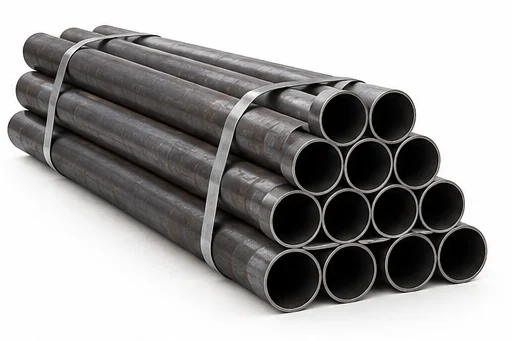
Illustrative bundle of round steel pipes with visible hollow ends
UNDERSTANDING YOUR MATERIAL

One strip.
A continuous welded seam.

ERW stands for Electric Resistance Welded.

ERW pipes are formed from steel strip and joined along a longitudinal seam using electrical resistance heating and pressure. The finished pipe is then sized, cut and inspected to its specified requirements.

This guide explains a typical manufacturing sequence. Line layouts, heat treatment, finishing and testing vary with the manufacturer, grade and product standard. Hariom Enterprises can discuss pipe supply and the documentation required for your enquiry.

A CLOSER LOOK

How ERW pipe is made.

01

Coil selection & slitting

Steel coils are selected to the required grade and thickness. Slitting produces strip of the width needed for the intended pipe diameter. Coil identity and material records provide the starting point for traceability.

Grade · Thickness · Strip width
02

Decoiling & strip preparation

The strip is unwound, levelled and fed into the mill. Where the line uses continuous operation, strip ends are joined and an accumulator helps maintain feed while coils are changed.

Steady feed · Prepared strip edges
03

Progressive roll forming

A series of forming rolls gradually bends the flat strip into a round, open-seam tube. The strip edges are brought together in a controlled position ready for welding.

Flat strip → Open-seam tube
04

High-frequency ERW welding

Electrical resistance heats the meeting strip edges, typically using high-frequency current. Squeeze rolls press the heated edges together to form the longitudinal weld, generally without adding filler metal.

Heat · Pressure · Longitudinal seam
05

Weld bead removal

Excess external weld bead is removed by scarfing as required. Internal bead control or removal depends on the product specification, pipe dimensions and the mill equipment used.

Seam profile · Surface finish
06

Heat treatment & cooling

Where specified, the weld seam or pipe undergoes the required heat treatment. Cooling then brings the material to a suitable condition for subsequent processing. The treatment route depends on the grade and applicable standard.

As specified for the product
07

Sizing & straightening

Sizing rolls bring the tube to the required outside diameter and roundness. Straightening and dimensional control help achieve the tolerances specified for the finished pipe.

Outside diameter · Roundness · Straightness
08

Cutting & end finishing

The pipe is cut to the specified length. End preparation can include deburring, facing, bevelling or threading according to the order and product standard.

Length · End condition
09

Inspection & specified testing

Dimensional checks and visual inspection are combined with the tests required by the standard and purchase order. These may include non-destructive weld examination, hydrostatic testing or mechanical tests, as applicable.

Dimensions · Weld checks · Test records
10

Marking, finish & bundling

Pipes are identified and prepared for dispatch. Protective coating, galvanising, end protection and packing are applied where specified. Bundles and documentation should correspond to the confirmed order.

Identification · Protection · Dispatch
FROM PROCESS TO PROCUREMENT

Specify the pipe.
Then confirm the details.

Manufacturing method alone does not establish a pipe’s grade, pressure rating or suitability. Start with the standard and specification for your application.

Explore the round-pipe weight calculator

Include these details in your enquiry

  • Outside diameter, wall thickness and required length
  • Steel grade and applicable product standard
  • Quantity and delivery location
  • End condition, finish or coating requirements
  • Inspection, testing and mill documentation requirements
Enquire about ERW pipes
PIPES FOR YOUR NEXT PROJECT

Bring us the specification.
Let’s discuss the supply.

Chat with us